The pre-purchase inspection is the cheapest insurance policy in used-car shopping, and roughly half of the buyers I help end up skipping it because the seller pressures them or because $200 feels like a lot of money on top of a deposit. The math on that decision is bad. A real PPI catches the kind of issues that cost $1,500 to $4,000 to fix on the same day you bring the car home, and it gives you negotiating leverage on items the seller didn’t disclose. The trick is knowing what a good inspector actually looks at, what they’re missing, and how to read the report when you get it back. After years of walking buyers through this — and watching the ones who skipped the PPI come back with the problem they paid not to find out about — I’ve ended up with a clear set of opinions about when the inspection earns its money and when it doesn’t.
Key takeaways
- A standard PPI in 2026 runs $150–$300; specialty PPIs (Porsche, Mercedes, classics) run $300–$600
- The inspector should be a mechanic familiar with the specific platform, not a general shop pulling the car onto a lift for an hour
- A real PPI includes a road test, scanner review with all modules, and a lift inspection — phone-only photo PPIs aren’t worth the money
- The most valuable items the report flags are usually frame, transmission, and electronic-module issues that don’t fail emissions but will fail soon
- Sellers who refuse a PPI are telling you something — that’s the data, take it as such
What a good PPI actually includes
The phrase “pre-purchase inspection” covers a wide range of work, and the gap between a thorough PPI and a perfunctory one is the difference between a useful report and a $200 piece of paper. A competent shop running a real PPI does roughly the following.
The car gets a road test of at least 20 minutes that includes highway speeds, hard braking, full-throttle acceleration, and at least one cold start. The mechanic listens for issues that only show up in motion — driveline vibrations, transmission shift quality, brake pulsation, suspension noise — and notes whatever isn’t right. Cars driven only at 30 mph in the parking lot can hide a long list of problems.
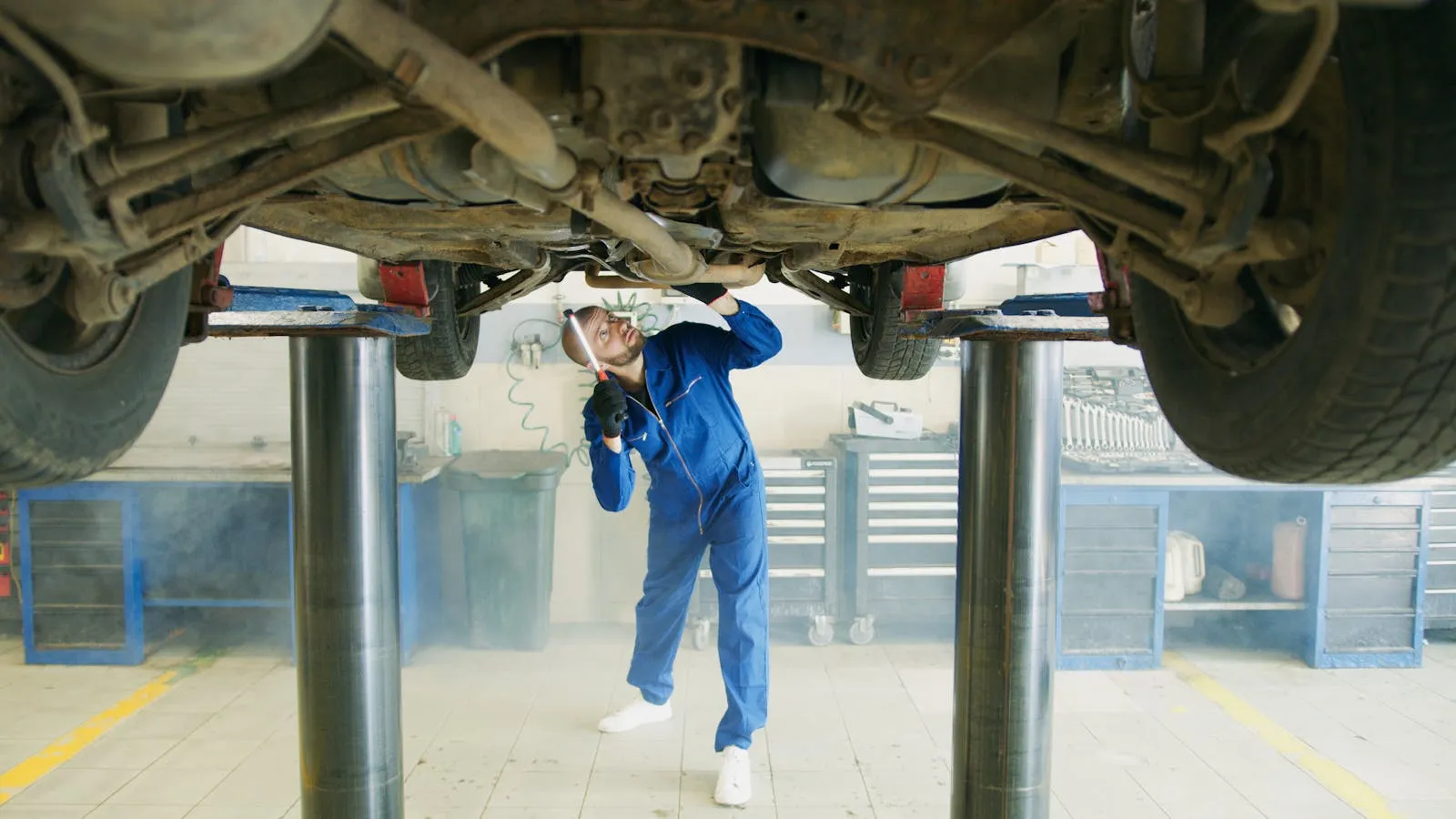
The car goes on a lift. The mechanic inspects underbody for frame damage, evidence of accident repair, fluid leaks, exhaust condition, suspension component wear, ball joints, tie rods, control arm bushings, sway bar links, drive shaft and CV joint condition, oil pan, transmission pan, differential, transfer case, and the general condition of the chassis. For cars from regions that salt their roads, this is where rust assessment happens.
The car gets a scanner attached to the OBD-II port, but a thorough mechanic does more than read the powertrain codes. They pull codes from all available modules — body control, ABS, transmission, climate, infotainment — and check for stored history that the dash light might have been cleared on. They review readiness monitors to confirm the car is actually ready for emissions testing rather than freshly cleared. On modern cars, they look at module software versions and recall completion status.
The visible mechanical items get checked: tire condition and DOT date, brake pad and rotor measurement, fluid levels and condition, battery test, alternator output, all lights and accessories functional, glass condition, cosmetic items including paint depth measurement on body panels to detect repaint or filler.
A standard PPI takes 60 to 90 minutes of shop time. A thorough one on a more complex vehicle takes longer. If the shop is offering “PPIs in 30 minutes” for $80, you’re not getting the inspection you think you’re paying for.
What it costs in 2026
PPI pricing has gone up alongside general shop labor rates. The numbers I see in 2026 across most metro markets:
A standard PPI on a mainstream vehicle (most domestic, Japanese, and Korean cars) runs $150 to $300 at independent shops and franchised dealers. Mobile PPI services that come to the seller’s location run $200 to $400 plus travel. Shops with dedicated used-car inspection programs sometimes have flat-rate packages.
Specialty platforms cost more because they require platform-specific tooling and expertise. European luxury (Porsche, Mercedes, BMW, Audi) typically runs $300 to $600 at marque specialists, sometimes more for cars that need ISTA, GT-1, PIWIS, or other platform-specific software for proper module review. Classics and exotics run higher still, sometimes $500 to $1,000 depending on what level of inspection is appropriate.
The price differential is usually justified. A general shop running BMW PPIs without ISTA is going to miss things that the BMW specialist catches in 20 minutes with the right tooling. The savings on the cheaper inspection are typically lost in what the inspection misses.
For cars under $10,000, the standard PPI is the right move. For cars over $40,000 — luxury, performance, or rare — paying up for a specialist is almost always worth it.
What the report actually flags
A useful PPI report categorizes findings by severity. The good shops use a structure that separates immediate safety issues, items that will need attention soon, items that aren’t ideal but aren’t urgent, and cosmetic notes.
The report’s most valuable section is usually the items the buyer wouldn’t have caught on their own. Most buyers can identify obvious cosmetic flaws — paint scratches, worn upholstery, scuffed wheels — without paying anyone. The PPI is earning its money on the items that require lift access, scan tools, or experience with the specific platform.
The categories I watch for most carefully when reading a PPI report:
Frame and structural integrity. A car with prior accident damage that wasn’t repaired correctly is a long-term problem that doesn’t show up in normal driving. Misaligned panel gaps, paint depth variance, weld evidence in unexpected places, and frame measurement discrepancies are all signals that get caught on a lift inspection.
Transmission behavior. Shift quality, fluid condition, pan dropout for ferrous debris on automatics, and clutch engagement on manuals are all things the inspector evaluates that a buyer can’t easily verify on a test drive. A transmission that’s about to fail often shifts fine until the day it doesn’t.
Module health and recall status. A car with stored codes in non-powertrain modules that aren’t lighting the dash today is often a car that will be lighting the dash next month. Open recalls that haven’t been completed are the seller’s responsibility but become the buyer’s problem if not handled before purchase. The PPI report should list both.
Fluid contamination. Coolant in the oil, oil in the coolant, transmission fluid color and smell, brake fluid condition, power steering fluid contamination — these are diagnostic of upcoming problems that are expensive to fix. A PPI that doesn’t pull dipsticks and look at fluid quality is missing something.
Underbody rust progression. The difference between surface rust on suspension components and structural rust in frame rails is the difference between a $0 issue and a $4,000 fix. The inspector should note location and severity in detail.
What a PPI typically misses
A few categories of issue regularly slip past even a thorough inspection, and pretending otherwise sets buyers up for unfair surprise.
Intermittent electronic issues that aren’t currently active in the car’s logs. If a module is misbehaving once a week and the inspection catches the car on a good day, the report says everything is fine. The next time it fails, you own it.
Slow-developing mechanical issues that are below the threshold of measurement. A timing chain that’s stretched but not yet failing. Piston ring wear that’s producing slightly elevated oil consumption but no smoke. A torque converter that’s losing efficiency but still functional. These often don’t show in a one-hour inspection.
Body filler under thick paint. Paint depth meters catch most filler work, but a skilled body shop can apply filler thin enough to defeat the meter on individual panels. On older or repainted cars, accept that you might be missing some history.
Issues that only appear under load conditions the inspector didn’t simulate. Cooling system performance on a hot day with sustained highway speed. Transmission behavior when towing. Engine performance at altitude. The road test catches a lot but it doesn’t simulate every condition the car will see.
The PPI is a high-coverage, high-confidence assessment of the car’s current condition — not a guarantee against future problems. A car that passes a PPI cleanly can still develop issues a month later. The report reduces risk; it doesn’t eliminate it.
Choosing the inspector
The best PPI inspector is a mechanic who works on the specific platform regularly. For a Honda, a Honda specialist or a high-volume independent. For a Porsche, a Porsche specialist with PIWIS. For a Land Rover, someone who knows the platform’s specific failure points.
Avoid the seller’s recommended shop. The conflict of interest is obvious and the inspection won’t be neutral. If a seller insists their shop must do the PPI, that’s a signal to walk away from the deal.
Avoid the dealership the seller is trading the car in to. They have a financial interest in the car’s condition being acceptable. Independent third-party inspectors only.
For local sellers, ask the shop to do the inspection at the shop’s location, with the seller bringing the car. This filters out sellers who are uncomfortable with the inspection — which is exactly the filter you want — and keeps the inspection in a controlled environment with proper tooling.
For long-distance purchases, mobile PPI services that come to the seller’s location work, but vet the service. Read reviews. Confirm they have lift access at the seller’s location or bring proper jack equipment. A mobile PPI conducted in a parking lot without a lift is missing the underbody review that’s half the value of the inspection.
Reading the report
When the report comes back, the first thing to look for is whether the report’s findings match the seller’s representations. A seller who said the car has no issues and a PPI that shows three pending repairs is a seller you should reconsider. The disconnect tells you about the seller as much as about the car.
The second thing is the dollar value of the items flagged. A car priced for sale should have its current condition reflected in the price, with a small margin for items the seller didn’t know about. If the PPI flags $4,000 in needed repairs on a car priced as if those repairs were already done, that’s the negotiating opening.
The third is whether the items flagged are deal-killers or negotiating points. A $400 oxygen sensor replacement is a negotiating point. Frame damage from a prior accident is a deal-killer. The categorization matters more than the dollar total.
A clean PPI report — no major findings, normal wear items consistent with mileage — is a strong signal to proceed. A clean report on a high-mileage car is more meaningful than a clean report on a lower-mileage car, because the wear-item check is a more substantive review on the older vehicle.
When to skip the PPI
There are a few scenarios where the PPI doesn’t add enough value to justify the cost.
Certified pre-owned vehicles from franchised dealers come with manufacturer-backed inspections and warranty coverage. The CPO inspection isn’t always rigorous (the CPO process is more variable than buyers assume), but the warranty backstops the major items. If you’re buying CPO from a franchised dealer with the manufacturer’s CPO program, the PPI is optional.
Cars under $5,000 sometimes don’t justify the inspection cost. A $200 PPI on a $4,000 car is 5% of the purchase price, and the inspection might find $1,500 of items on a car at that price point that isn’t unusual. If you’re buying at the bottom of the market, you’re already accepting that the car has issues.
Cars from a personal connection where you know the maintenance history — a friend’s car, a family member’s trade-in, a previous owner you know personally. The PPI value is reduced when you have direct knowledge of how the car was maintained.
For everything else, especially private-party purchases on cars over $10,000, the PPI is worth the money every time.
Bottom line
A good PPI in 2026 costs $200 to $300 on a mainstream vehicle and pays for itself the first time it catches a $2,000 issue you wouldn’t have spotted. The buyers who skip it are the ones I see calling me the next month asking what to do about the issue the seller “didn’t know about.” The buyers who do it are the ones who either close the deal with confidence or walk away with their deposit intact and shop the next car. Pick a shop that knows the platform, ask for a thorough inspection that includes road test and lift time, and read the report critically. The $200 is the cheapest part of the whole deal.