The brake pad question is one of the most over-complicated decisions in performance modification, mostly because the people answering it are usually telling you about their own setup rather than yours. A track-only car with race-spec calipers and dedicated pads is a different problem than a street car that sees four HPDE days a year. The pad choice for the second category — daily driver that occasionally goes to the track — is where most enthusiasts get bad advice. I’ve made the mistake myself of running pads that were too aggressive for the actual driving I was doing, and the cost of getting it wrong is rotor wear, dust, noise, and pads that don’t work when you need them to. Here’s how I approach the decision now, after enough seasons of trial and error to have opinions worth sharing.
Key takeaways
- Most “street/track” pads are a real category and work well for cars seeing fewer than eight track days per year
- True track pads have terrible cold bite and will make your daily commute genuinely worse
- Friction coefficient matters less than friction stability across the temperature range you actually use
- Rotor compatibility is real — some aggressive pads will eat OEM rotors quickly
- Pad bedding procedures vary by compound and skipping it produces the same problems people blame on the pad itself
What “street/track” actually means
The category exists because there’s real demand from people in exactly your situation. A street/track pad is engineered to have acceptable cold bite for daily driving, useful friction up through the temperature range a typical HPDE generates, and rotor wear that’s harder than OEM pads but not destructive.
The pads in this category — Hawk HP+, EBC Yellowstuff, Carbotech Bobcat 1521, PFC Z-Rated, Stoptech Sport — share some characteristics. They have higher friction coefficients than OEM pads (typically 0.40 to 0.50 mu compared to OEM’s 0.35 to 0.40). They have better thermal stability than street pads, holding their friction coefficient up to around 600°C compared to OEM pads that start fading at 400°C. They generate more dust than OEM pads but less than true track pads. They make some noise — usually a low squeal at low speed — that most enthusiasts learn to live with.
What they don’t do well is replace either pure street pads on a car you don’t track, or true track pads on a car you take seriously. They’re a compromise, and the compromise works for the use case it’s designed for.
When a true track pad makes sense
If you’re doing more than eight track days a year, or running a car with significantly upgraded calipers, or driving sessions long enough that the brakes are seeing repeated 700°C+ exposures, the street/track category isn’t enough. At that point you’re looking at swapping pads at the track for something like Carbotech XP10/XP12, Hawk DTC-60/DTC-70, or PFC 08/11.
These pads have minimal cold bite. The first stop in your driveway after installing them feels like the brakes have failed. The pedal sinks, the car barely slows down, and you’ll question whether the master cylinder is going. After a couple of warming stops they wake up, but you’ll never get them to behave like street pads. They also wear rotors aggressively if you cross-shop them with rotors that aren’t designed for the heat — and they’re loud enough that you’ll hate driving around the paddock with them in.
The standard answer for owners who want this performance is to keep two sets of pads: street/sport pads for the drive to the track, and true track pads installed before sessions and removed before the drive home. That works but adds an hour of work to each track event, plus the cost of a second set of pads and the storage to deal with them.
Friction stability versus peak friction
The marketing for high-performance pads usually leads with friction coefficient. “0.50 mu pad!” is the kind of headline you see. Peak friction matters less than the friction’s stability across the temperature range you actually use.
A pad with 0.50 mu peak friction at 500°C but 0.30 mu at 100°C is going to feel inconsistent on the street. Your morning commute uses the brakes at 100 to 200°C maximum. If the friction coefficient drops 40 percent in that range, the pedal feel changes meaningfully depending on whether the brakes are warm. Drivers describe this as “wooden” or “vague” or “unpredictable” — and it’s usually the friction curve they’re feeling, not the pad failing.
Look at friction-temperature curves when manufacturers publish them. The good street/track pads hold their friction coefficient within a narrower band across the 100°C to 600°C range. That consistency is what makes the pedal feel right whether you’re slowing for a stoplight or trail-braking into a corner.
Rotor compatibility is real
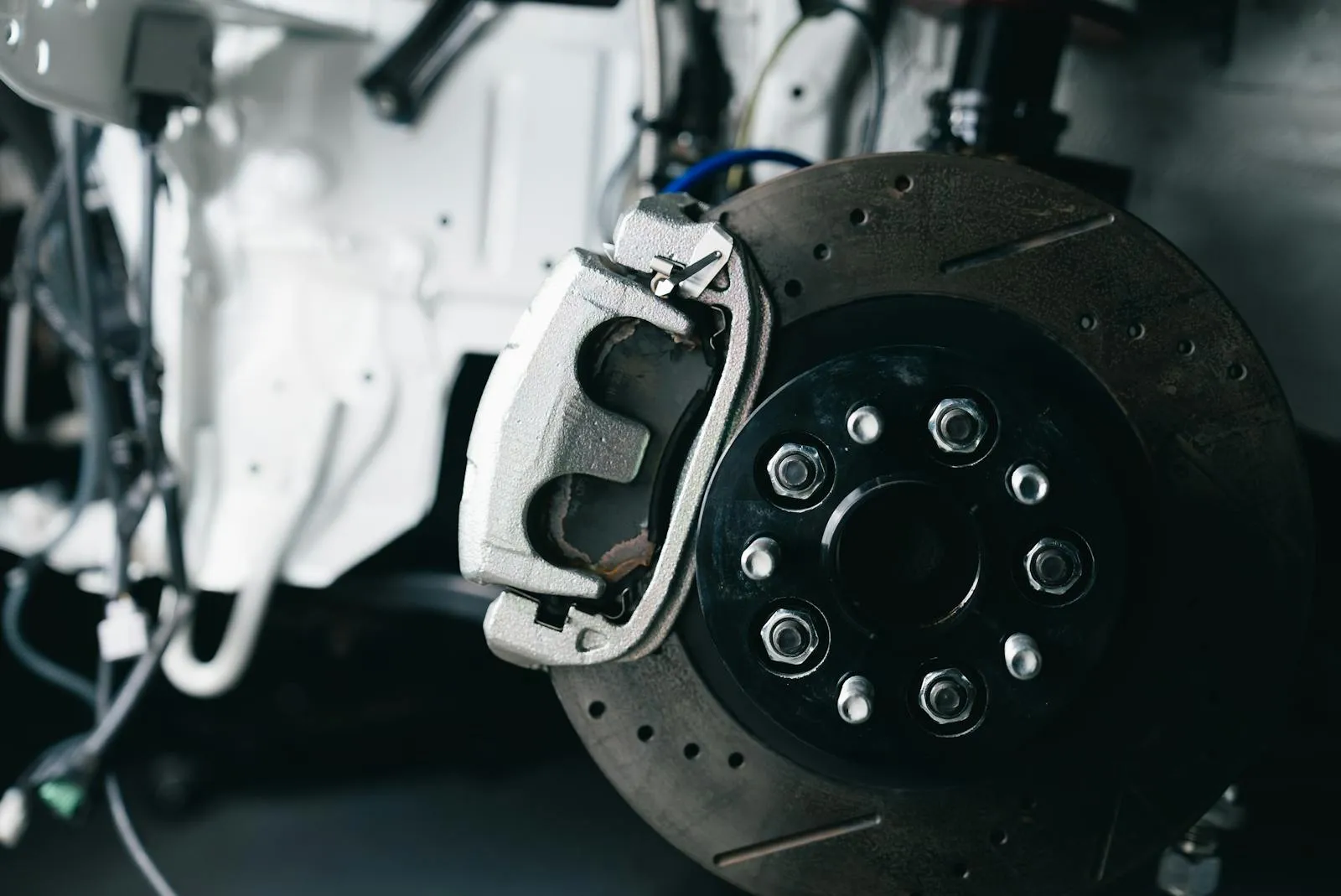
Higher-friction pads work the rotor harder. Some compounds are abrasive enough to chew through OEM rotor metallurgy faster than the pad wears. If you’ve ever pulled a wheel and seen a rotor with deep grooves and a worn-down friction surface after only 10,000 miles, you’ve seen this happen.
The good news is that the street/track pad category is generally rotor-friendly. Hawk HP+, EBC Yellowstuff, and similar pads work fine on OEM-grade rotors. The aggressive end of the spectrum — Carbotech XP series, PFC race compounds — should be paired with rotors specified for high-temperature use, typically a two-piece rotor or at minimum a high-carbon iron rotor that can handle the thermal cycling.
If you’re on OEM rotors and choosing a street/track pad, the pad shouldn’t significantly change your rotor wear pattern. If you start seeing accelerated wear, scoring, or heat checking, that’s a sign the pad-rotor combination is wrong rather than the rotors being defective.
Bedding matters more than people think
Bedding is the process of laying down a transfer layer of pad material onto the rotor face during the first heat cycles. A properly bedded pad-rotor combination has a thin, even layer of pad compound on the rotor that allows the pad to work against itself rather than against bare metal. Skip the bedding step and the pad never reaches its design performance.
The bedding procedure varies by compound. Most street/track pads want six to ten medium-pressure stops from 60 to 30 mph with no full stops, followed by a cooling period. Track pads want a more aggressive bedding with higher-speed brake events. The manufacturer’s bedding instructions are specific and worth following — they’re not generic.
I’ve seen plenty of complaints about pads that “don’t work” when the actual problem was that the pads were never bedded. The driver installs them, drives normally, and notices the pads don’t feel right — but they never put the pads through the heat cycles that build the transfer layer. The fix is doing the bedding, not buying a different pad.
Picking for your specific situation
The decision tree I use:
If you’re doing zero to two track days a year and the rest is daily driving, an upgraded street pad like the EBC Redstuff, Akebono Performance, or Hawk Performance Ceramic is enough. You don’t need street/track unless you want the extra margin.
If you’re doing three to eight track days a year and want the same pad to handle daily duty, the street/track category is the right answer. Pick from Hawk HP+, EBC Yellowstuff, Carbotech 1521, PFC Z-Rated based on price, dust tolerance, and your specific car’s brake setup. None of these are wrong choices.
If you’re doing more than eight track days a year, or running a track car that gets occasionally driven on the street, you should be running two sets and accepting the maintenance overhead. Trying to find a single pad that does both at this volume is the wrong problem to solve.
If you’re upgrading from OEM and you’re not sure how often you’ll actually go to the track, default to the street/track category. They work fine on the street for the rare driver who never tracks, and they’re ready when you do.
Bottom line
Brake pad selection for a dual-purpose car comes down to honest assessment of how often you actually use the car for what. The street/track category exists because most enthusiasts genuinely fall into it, and the pads in that category work for the use case. The mistake to avoid is letting track-day envy push you into a pad that’s wrong for the 95% of driving that isn’t at a track. Get the friction-stability right for your temperature range, bed the pads correctly when you install them, and stop worrying about whether the peak coefficient on a competitor pad is 0.02 higher. The car you actually drive will be better for it.