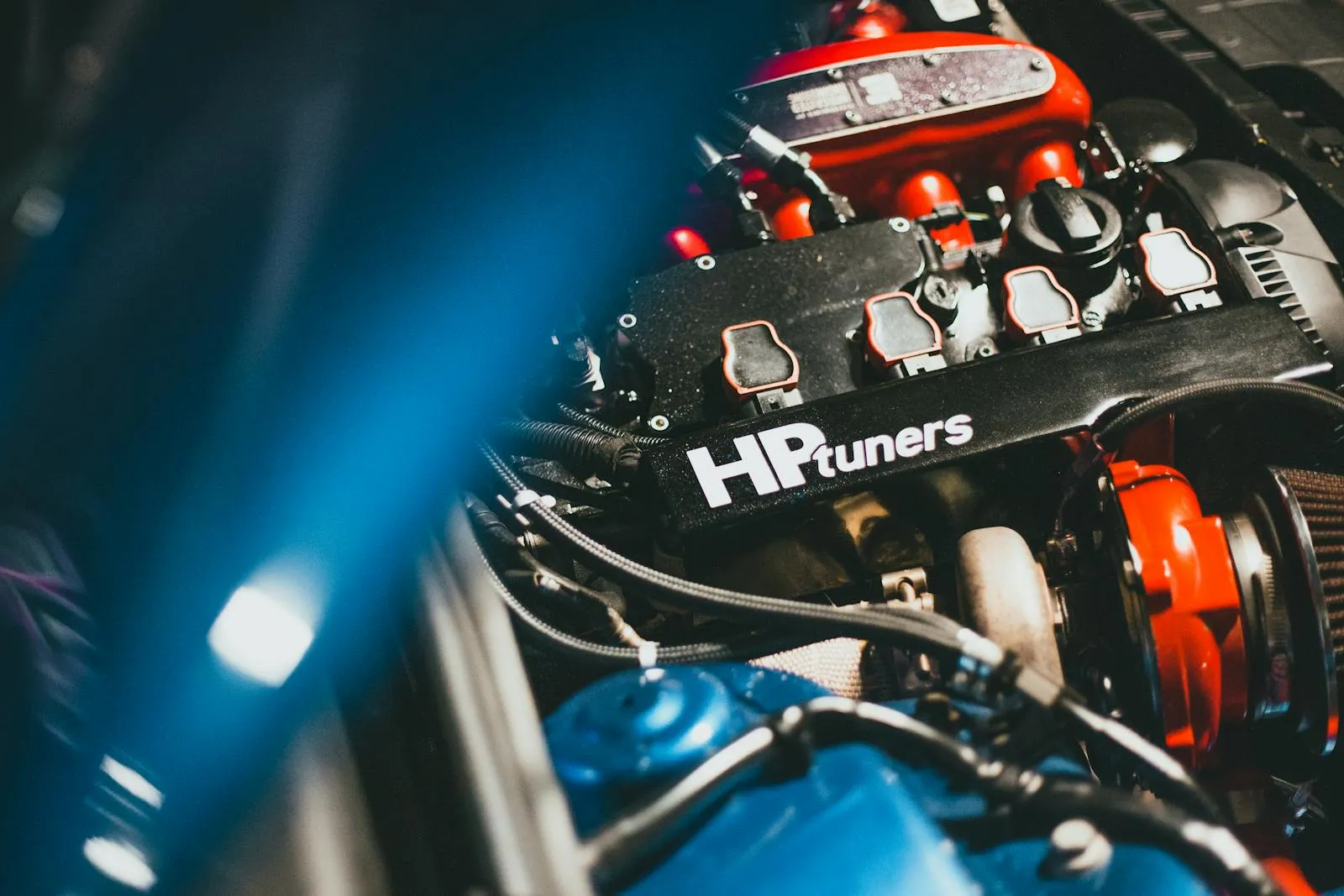
A tune that felt perfect on a 55° spring drive can be in real trouble at 95° in July, and the kind of trouble depends on how the calibration was done. Mass airflow tables compensate well for ambient changes on most stock-engined cars, which is why your factory-tuned daily doesn’t care what month it is. A street car with a turbo or supercharger and a custom tune is a different story. The corrections that work in spring conditions can stack against you in summer, the knock margin shrinks as intake air temps climb, and the ECU’s protective enrichment behavior changes how the car actually performs. If you’re running a tune on a forced-induction car, the first hot week of the year is when the calibration earns or loses its money. The check below is the one I run on my own car every year before the heat shows up — and the one I push customers through if they bring me a setup that’s been quiet for six months.
Key takeaways
- Air density at 55°F is roughly 8% higher than at 95°F — same boost reading, less actual oxygen
- Most spring tunes weren’t logged at IATs above 100°F because those conditions didn’t exist when the tune was made
- The first lean-condition warning is often pulled timing in datalog rather than anything you’d feel
- E85 blended tunes get more sensitive in summer because pump E85 ethanol content drops in summer formulations
- A 30-minute summer-condition log session catches almost every issue before it becomes engine damage
What changes between spring and summer
Two things change measurably for a tuned engine between a 55° spring day and a 95° summer day, and both compound rather than cancel.
The first is air density. Cooler air is denser, so a given volume of intake air carries more oxygen molecules. At sea level on a 55° day, you’ve got roughly 1.225 kg/m³ of air. At 95°, that drops to about 1.13 kg/m³. That’s an 8% reduction in oxygen mass at the same boost pressure. A tune calibrated for the spring condition is now running 8% richer of stoichiometric than it was — sometimes that’s fine, sometimes it pushes the calibration outside the window where it’s safe.
The second is intake air temperature, which is what the ECU actually sees and responds to. On a turbocharged car, IAT climbs faster in summer because ambient air is hotter going into the compressor and the intercooler can only reject so much of the temperature rise. A tune that saw 110°F IATs on a hot spring afternoon is going to see 140°F IATs in real summer driving. Most ECUs reduce timing as IAT climbs to maintain knock margin, which the driver experiences as the car feeling slower above 80°F ambient even though boost numbers look the same.
The two effects together produce a calibration window where the air is less dense, the IAT is higher, and the knock environment is worse than the spring conditions the tune was logged in. If the tune was made conservatively, the car just runs flatter in summer and you might not notice. If the tune was made aggressively to hit a peak number on a cool day, summer is where the trouble starts.
Why MAF-based tunes handle this better than speed-density
If your tune is MAF-based, the mass airflow sensor is directly measuring the actual mass of air entering the engine, which already accounts for density changes from temperature. The fuel calculation uses that measured mass to determine the right injector pulse width, and the result is air-fuel ratio that stays stable across ambient conditions.
Speed-density tunes calculate airflow from manifold pressure, intake temp, and engine speed using a volumetric efficiency table. That’s a calculation, not a measurement, and it works as well as the table is populated. If your tuner didn’t have hot-day data when the tune was logged, the VE table is filled in with assumptions that may or may not be right at high IATs. This is where speed-density tunes fall apart in summer — the table is extrapolating beyond where it was actually validated.
The practical implication: if you’re on a speed-density tune (Cobb Stage 3 calibrations, MHD on BMW N54/N55, COBB AccessPort with custom maps on Subaru EJ engines, EcuTek on various platforms — many of these have moved partly or fully to speed-density), the pre-summer log is more important than for a MAF-based tune. The MAF tune adapts to conditions automatically; the SD tune trusts the table the tuner built, which may not have been built for July.
What to log before the first hot week
The pre-summer log session has a specific procedure. Load the engine at conditions that match what summer driving will produce, then look at how the calibration is responding.
Pick a hot afternoon if you can, ideally above 80°F ambient. Get the car up to operating temperature with normal driving. Then run a sequence of pulls at varying loads that represent how you actually drive: a couple of 3rd-gear pulls from 3,500 to redline at full throttle, a few 4th-gear part-throttle pulls at 70% throttle, and a sustained run on the highway at cruise to capture steady-state behavior.
The variables to log are airflow (or MAP and IAT for SD tunes), commanded AFR, actual AFR (from a wideband — the OEM narrowband won’t tell you what you need), ignition advance, knock retard or feedback knock (whatever your platform calls the live knock signal), and intake air temperature. On most modern platforms you’ll also want to capture fuel-trim values, both short and long term, to see how the ECU is correcting in real time.
What you’re looking for in the log is straightforward. Actual AFR should match commanded AFR within reasonable tolerance — typically within 0.2 to 0.3 AFR points on a well-tuned car. Knock retard should be near zero or negative on a car that’s running well. Long-term fuel trims at idle and cruise should be within ±5%. IAT should peak somewhere reasonable for your setup and recover when you let off.
If any of those metrics are out of range — actual AFR significantly leaner than commanded, knock retard pulling timing during pulls, fuel trims hitting their adjustment limits — the tune isn’t ready for summer.
What “running lean” actually looks like in a log
The phrase “running lean” gets used loosely. What you’re actually looking for in a datalog is one or more of three patterns.
The clearest is commanded versus actual AFR divergence. The ECU is asking for, say, 11.5:1 at full load. The wideband is reading 12.2:1. That’s an 0.7-point lean condition that the closed-loop fueling isn’t catching, usually because the load is in the open-loop region where the ECU is using the table directly. On a forced-induction car at full boost, that’s enough lean to cause damage on a long pull. Fix the table or back the boost down until you can get back to a tuner.
The second is rising knock retard during a pull. The ECU detects knock activity and pulls timing to protect the engine. A small amount of corrective retard during transition events is normal — sustained retard during a steady pull means the calibration is running closer to the knock limit than it should, and summer conditions made the margin smaller than the tune assumed.
The third is positive long-term fuel trims trending up over the course of a drive. LTFTs of +5% or higher at cruise mean the ECU is adding fuel because the open-loop calibration is delivering less fuel than the closed-loop sensors expect. That’s a calibration drift signal — the tune was right when it was made and is no longer right at current conditions.
Any of these patterns means it’s time to talk to your tuner before you drive the car hard in summer conditions.
E85 changes through the season
If you’re running E85 or an E85 blend, summer brings a separate problem worth flagging. Pump E85 in the United States is required to contain between 51% and 83% ethanol by volume, and the actual content varies by season. Summer formulations typically run lower on ethanol — closer to the 51-60% end — to manage vapor pressure for emissions purposes. Winter formulations run higher.
A flex-fuel tune with an ethanol content sensor handles this automatically. A static E85 tune calibrated against winter pump fuel will be running leaner of stoichiometric in summer because the actual ethanol content is lower than the tune assumed. The math is similar to the temperature density issue: the calibration is asking for a certain mass of fuel for a certain mass of ethanol, and the pump is delivering less ethanol than the tune was built around.
If you’re on a static E85 tune, the pre-summer drill is to either confirm your ethanol content with a content tester (cheap and worth it — Innovate, Zeitronix, and others sell them), or to put the car on a flex-fuel tune that adapts. Or run a known race ethanol that has consistent content across the year, which is more expensive but takes the variable out of the equation.
Cooling and pre-tune service
Before the pre-summer log session, a couple of mechanical checks are worth doing because they affect what the tune is doing.
Coolant should be fresh enough to actually cool. Coolant degrades over time and stops transferring heat efficiently after a few years. If your coolant is original on a car that’s seen track time or hard use, replace it before you hot-tune.
Intercooler fins should be clean. Bugs and road debris in the fins reduce the intercooler’s heat-rejection capacity, which raises IATs at boost. A pressure wash from inside out (gentle, not directly into the fins) clears most of what gets stuck.
Air filter should be clean. A restricted air filter doesn’t usually cause direct tune issues but it does change MAF readings and can mask other problems. If you’re not sure when you last cleaned it, do it.
Spark plugs should be appropriate for your boost level and gapped correctly. Plugs that worked fine in winter sometimes start blowing out spark in summer when cylinder pressures are pushing harder. If you’re approaching service interval, do plugs before the hot weather arrives.
These aren’t tuning items but they’re the variables that make a tune behave differently across seasons. Sorting them before logging means the log reflects calibration issues rather than mechanical drift.
When to involve the tuner
If your pre-summer log shows no concerning trends — AFR matching commanded, no knock retard, fuel trims within range — drive the car. The tune is robust enough for the season.
If the log shows mild drift — small AFR divergence, occasional minor knock retard during transitions, slightly elevated trims — most tuners will take a copy of the log and a written description and ship you a revision over email. Many platforms support remote tune updates without a dyno visit.
If the log shows clear problems — sustained lean conditions at boost, meaningful knock retard during pulls, fuel trims pinned at the limit — stop driving the car hard and talk to the tuner directly. A dyno session is cheap insurance compared to a damaged engine.
The mistake I’ve watched too many people make is logging the car, seeing something concerning, telling themselves it’s probably fine, and then running it hard for two months until something gives. The log was the warning. A tune revision costs a tiny fraction of a rebuild.
Bottom line
A spring tune can carry through summer fine, or it can quietly drift into a window the calibration wasn’t built for, and the difference is whether you logged the car before the hot weather hit. The check takes thirty minutes on a hot afternoon and tells you everything you need to know about whether your tune is ready for the season. Forced-induction cars are the ones where this matters most, and speed-density tunes are the ones where summer drift is hardest to predict from the spring data the tune was built on. Run the log, look at the numbers, and make decisions from data instead of feel. The car will be better for it, and you’ll have a clean datalog to send your tuner if anything looks off.