Ask ten enthusiasts which is better — turbo or supercharger — and you’ll get ten answers based on what they run or what they want to run. That’s not useful for someone making a real decision. The turbo-versus-supercharger question has a right answer for a specific car, a specific intended use, a specific tolerance for complexity, and a specific budget. The wrong answer is picking based on peak dyno numbers alone. I’ve built both and driven both on similar platforms. Here’s the framework I actually use when helping someone decide which direction to go on their own build.
Key takeaways
- Supercharger kits deliver boost instantly, across the entire RPM range — the driving feel is linear and predictable
- Turbo kits deliver higher peak power per dollar but require RPM to build boost — drivability at low speeds is different
- Thermal management on supercharged engines is generally more straightforward than on turbocharged ones
- Installation complexity and serviceability favor superchargers on most applications
- The right answer depends on how you’ll drive the car 95% of the time, not how it performs at full throttle
How each system builds power
A supercharger is mechanically driven off the engine’s crankshaft via a belt. It spins in direct proportion to engine RPM, so boost is available immediately at any RPM where the engine is turning. There’s no lag, no spool, no waiting — the moment you open the throttle, the supercharger is already compressing air.
A turbocharger is driven by exhaust gas spinning a turbine. Boost builds as exhaust flow increases, which requires RPM and load. Modern ball-bearing turbos with appropriate sizing can spool quickly, but they cannot deliver boost at idle RPM, and the relationship between throttle input and boost output is not linear — it’s a function of how much exhaust the engine is producing at that moment.
The practical driving difference: a supercharged engine feels like a larger-displacement engine with more immediate response. A turbocharged engine feels like a smaller-displacement engine that wakes up dramatically when boost comes in. Both can be fast. They’re fast in different ways.
Drivability and street feel
For street driving, the supercharger almost always delivers a more predictable, more usable power band. Part-throttle response is direct. Low-RPM torque is strong. The car feels quick in the conditions most street cars actually encounter — 2,500–5,000 RPM with varying throttle input.
A turbocharged engine on the street tends to have two distinct behaviors: below the RPM where boost is meaningful, it drives like a slightly-smaller naturally-aspirated engine; above that RPM, it delivers the promised power. Drivers who spend most of their time below the boost threshold aren’t feeling the full benefit of the modification.
For a dedicated track car, this calculation flips. At track speeds, engines operate in the RPM range where turbos are in their happy zone. The peak-power advantage of a large turbo matters because you’re actually using it. For a street car that sees occasional track days, the turbo feels less usable most of the time.
Heat and thermal management
Turbochargers live in the exhaust stream. They’re constantly exposed to temperatures that would destroy most engine components. Managing this heat — for the turbo itself, for surrounding engine-bay components, and for the underhood air temperature that affects the intake charge — is a real engineering challenge on a turbocharged build.
Superchargers generate less under-hood heat. The compression happens mechanically, without exhaust gas routing, and the heat output is more contained. Intercooler sizing on a supercharged application is still critical, but the overall engine-bay thermal management is typically more straightforward.
For a daily driver or frequently-driven street car, the cumulative effect of heat cycling on the engine and surrounding components matters. Turbocharged builds put more thermal stress on the system over time. Supercharged builds don’t eliminate this, but they generally have an easier time with it.
Installation complexity and serviceability
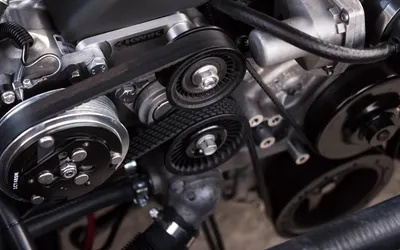
Supercharger installations are typically bolt-on — the kit includes a crankshaft-driven pulley, the supercharger itself, an intercooler system, the necessary tubing and fittings, and the tune. Installation is mechanically straightforward for anyone comfortable with engine work. Service access to things like spark plugs, fuel injectors, and other routine-maintenance items usually isn’t dramatically affected.
Turbo installations require exhaust manifold or header replacement, routing of hot-side and cold-side intercooler plumbing that often requires intercooler placement work, oil and coolant supply/return lines for the turbo itself, and in many cases modifications to the wastegate/blowoff valve management. Installation is more involved and tends to reduce access to other engine-bay components.
Serviceability over the long term: a supercharger has one major wear point (the bearings on the rotor assembly) and one accessory belt that wears in the normal course of use. A turbocharger has more wear points and more components to fail over time.
Cost per horsepower
Turbo kits typically deliver higher peak horsepower per dollar than supercharger kits. For a given budget, a turbo build will usually make more peak power than a supercharger build on the same platform. This is the single most common reason owners choose turbo — they want a specific power number, and the turbo path gets them there for less money.
The cost equation is more complex than peak numbers suggest, however. Turbo builds typically require more supporting modifications (fuel system upgrades, tuning complexity, stronger drivetrain components to handle the power delivery) that add up over the full build. A turbo kit that’s $2,000 cheaper than the equivalent supercharger kit may end up costing the same or more after supporting mods.
For a realistic budget comparison, price the complete build — kit, installation, supporting mods, tune — rather than just the kit itself. The difference between turbo and supercharger economics often narrows when the full build is considered.
Sound and feel
This is subjective but worth mentioning because it drives real decisions. Supercharged engines make a distinctive whine that some drivers love and others find annoying. A Roots-style supercharger has a different sound than a twin-screw or centrifugal design. The whine is audible from inside the cabin in most installations and is part of the character of the car.
Turbocharged engines can be quieter at part throttle and make distinctive sounds at boost onset — the spool-up, the blow-off valve release, the turbo flutter on rapid throttle-lift. Some drivers find this more engaging than the constant supercharger whine; others prefer the consistent mechanical sound of the supercharger.
Neither is objectively better. Drive cars with each before deciding, if you can. The sound is going to be with you for as long as you own the car.
The decision framework
How I actually decide when helping someone plan a build:
- What’s the car’s primary use case? Daily driver or occasional spirited use → lean supercharger. Dedicated track use → lean turbo.
- What’s your budget for the complete build, including supporting mods? Tight budget for maximum numbers → lean turbo. Budget for a balanced, well-engineered build → either works.
- How much complexity are you comfortable with? First forced-induction build → lean supercharger. Experienced with turbos → either works.
- What does the aftermarket offer for your specific platform? Some platforms have strong supercharger kit support; others have strong turbo kit support. Go with the direction that’s better developed for your specific car.
- What power target are you realistically going to use? If you’re chasing a number you won’t actually drive into regularly, recalibrate expectations before picking a path.
Bottom line
Turbo versus supercharger is a specific decision for a specific car. Neither is universally better. For most street-driven performance cars with owners who want an engaging, reliable, well-mannered result, the supercharger is the higher-percentage choice. For dedicated track cars where peak power and RPM-range performance matter more than low-RPM drivability, the turbo is often better. Match the system to how you’ll actually use the car, not to what sounds impressive in forum arguments.