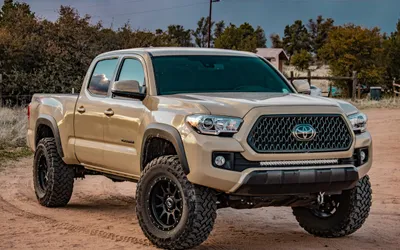
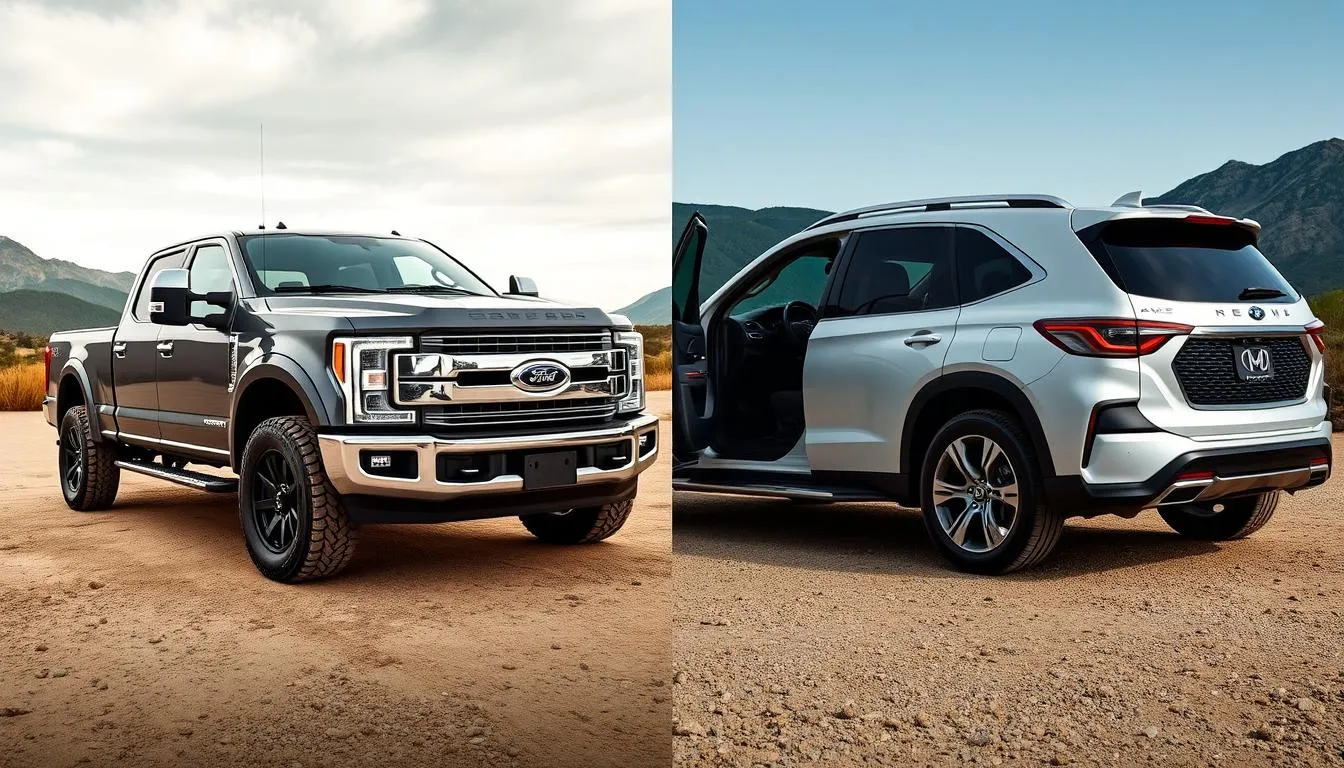
The truck-versus-SUV question almost always comes down to one thing: how often you actually need an open bed for dirty gear, towing, or oversized loads, versus how often you need passengers, weather-protected storage, and easier daily use.
A pickup usually wins for open-bed hauling and offers more heavy-towing configurations. A three-row SUV usually fits people, pets, and weather-protected luggage better. For a household that rarely uses a bed or trailer, the SUV is often the more honest fit; recurring dirty cargo or properly calculated towing can reverse that answer.
How we compared trucks and SUVs
This is a use-case comparison, not a ranking of every truck and SUV. We compared passenger layout, cargo type, towing math, parking, and published operating costs. Any capacity claim for a purchase should come from the exact vehicle’s door-jamb labels, owner’s manual, equipment configuration, and hitch label—not a model-family maximum in an advertisement.
For towing, our method follows NHTSA’s central advice: relate the loaded trailer and tongue weight to the tow vehicle’s axle and load ratings. For cargo, we treat an open bed and an enclosed cabin as different tools rather than pretending cubic feet alone settles the question.
Choose a Truck If…
- You tow at least once a month — boats, trailers, equipment, or campers
- You haul dirty, wet, or oversized cargo regularly (mulch, lumber, dirt bikes, motorcycles)
- You want bed-mounted accessories (toolbox, ladder rack, bed cap, fifth-wheel hitch)
- You work in a trade or a job that uses the bed
- You have driveway, garage, and parking space for the exact truck’s dimensions
Choose an SUV If…
- You move three or more passengers regularly, especially with car seats
- You park in tight urban spaces, parking garages, or compact driveways
- Your cargo is mostly groceries, sports gear, strollers, and luggage that needs weather protection
- You only tow occasionally and mostly something light (small trailer, popup camper, jet ski)
- The SUV on your shortlist has lower fuel or energy costs and is easier to park
Quick Comparison
| Need | Better Choice | Why |
|---|---|---|
| Heavy or frequent towing | Usually truck | More configurations offer the needed payload and tow equipment |
| Daily commute and tight parking | Usually SUV | Enclosed utility without an open bed; often a shorter footprint |
| Three rows of seating | SUV | Most pickups max at 5–6 seats |
| Dirty or oversized cargo | Truck | Open bed; no interior cleanup |
| Weather-protected cargo | SUV | Enclosed; dry and lockable |
| Off-road trail use | Either | Mid-size truck or off-road SUV (Wrangler, 4Runner, Bronco) |
| City parking | SUV | Shorter overall length; tighter turning radius |
| Resale value | Model-specific | Compare actual five-year values for the exact trim |
| Insurance cost | Model-specific | Quote both VINs; body style alone cannot predict your premium |
| Highway road-trip comfort | Model-specific | Test seat comfort, noise, and ride on the same route |
Towing: Use Payload, Not Just Tow Rating
The biggest mistake in truck-versus-SUV decisions is comparing only the maximum advertised tow rating. An “up to” number applies to a particular configuration and still has to work alongside the vehicle’s payload, axle, tire, hitch, and combined-weight limits. It is not automatically the rating of the vehicle on a dealer’s lot.
The constraints that actually matter:
- Payload — the weight placed on the vehicle, including passengers, cargo, accessories, and the trailer’s tongue weight. Use the vehicle’s own Tire and Loading Information label.
- Tongue weight — the downward trailer load carried at the hitch. The correct range is trailer- and vehicle-specific; use both manufacturers’ instructions and count it against available payload.
- GVWR / GAWR / GCWR — the maximum loaded vehicle, axle, and combined vehicle-plus-trailer ratings published for the exact configuration.
- Hitch and towing equipment — the receiver, ball mount, ball, safety chains, wiring, and brakes all need ratings and installation appropriate to the load.
A common pattern is a family choosing a vehicle from its headline tow rating, then adding people, cargo, accessories, and trailer tongue weight. The remaining payload can disappear before the trailer reaches the advertised maximum. That is why the calculation starts with the specific vehicle’s load label, not the largest number on the model’s webpage.
If towing is a real use case, photograph the door-jamb labels for the specific vehicle, read its towing section, and add the actual passengers, cargo, accessories, and tongue weight. NHTSA advises buyers to relate loaded tongue weight to the tow vehicle’s axle ratings. If the math has little margin, choose a better-equipped or higher-capacity vehicle instead of assuming any pickup will work.
Passenger Space and Third Rows
Most pickups seat five in a crew cab and six with a bench front seat. A few extended-cab options exist, but rear-seat space is tighter than what an SUV offers in the same overall length.
Three-row SUVs split into two categories:
- Mid-size three-row (Pilot, Highlander, Telluride, Ascent) — third row is usable for kids, tight for adults on long trips
- Full-size three-row (Suburban, Expedition, Sequoia, Wagoneer) — third row genuinely fits adults, with cargo room behind
If the third row will hold adults regularly, full-size is the honest answer. Mid-size three-rows are a compromise — fine for occasional use, cramped for daily three-row duty.
Cargo: Open Bed vs. Enclosed
A pickup bed is unmatched for anything that should not be in a passenger cabin: mulch, dirty bikes, gas cans, sheets of plywood, anything that smells. The trade-off is that the cargo is exposed to weather and to theft unless you add a tonneau cover or bed cap.
An SUV trades open-air capacity for security and weather protection. Published cargo-volume figures help, but compare them with every seat you expect to use; three-row cargo space can shrink sharply with all seats occupied.
The real question is whether your cargo is mostly clean and contained (SUV) or mostly dirty and oversized (truck).
Daily Driving Costs
Fuel economy varies by powertrain, drivetrain, tires, and configuration, not just body style. Compare the EPA label for the exact versions on your shortlist and estimate annual fuel from your own mileage. A hybrid SUV can be far cheaper to commute in than a full-size pickup, but a diesel or hybrid truck changes the comparison.
Other ownership costs:
- Insurance — get VIN-specific quotes. Trim, safety equipment, repair costs, location, and driver history can outweigh body style.
- Tires — price the factory size before buying; large wheels and off-road tires raise replacement costs on either body style.
- Parking — compare overall length, width, height, turning circle, and your garage opening with a tape measure.
- Depreciation — compare the exact trim and powertrain rather than assuming every pickup holds value better than every SUV.
Off-Road Capability
Both can work off-road, but the right pick depends on the trail.
- Light dirt and gravel — almost any AWD vehicle handles this
- Rocky trails, steep grades, water crossings — body-on-frame SUVs (4Runner, Wrangler, Bronco, Land Cruiser) and mid-size trucks (Tacoma, Ranger, Colorado off-road trims)
- Towing equipment to a trail — full-size truck, since you need both the tow rating and the payload margin
A unibody crossover can be a sound fit for maintained dirt roads and ordinary winter travel. Ground clearance, tires, recovery points, cooling, and manufacturer limits decide whether a particular route is appropriate.
Buyer Scenarios
Three patterns that come up constantly:
The “weekend truck” buyer — wants a pickup mostly for occasional materials runs and one annual camping trip. A tow-rated SUV plus a correctly matched rental utility trailer may cover that use without carrying an empty bed every day. Run the vehicle, hitch, trailer, payload, and tongue-weight numbers first.
The growing family — has two kids, a dog, and visiting relatives, then tows a small popup camper twice a year. A three-row SUV may be the better daily fit, but the exact SUV, hitch, payload, trailer, and tongue-weight math still have to work.
The trades or hauling business — tools every day, materials runs, real towing. This is where a truck is the right tool, full stop. Often a 3/4-ton (F-250, Silverado 2500) is the honest pick once payload is calculated.
The trap to avoid: buying for the vehicle you imagine using once a year, instead of the one you actually use weekly.
Primary sources and checks
- NHTSA: relate trailer tongue weight to tow-vehicle axle ratings
- NHTSA: secure cargo and avoid excessive trailer loads
- The exact vehicle’s Tire and Loading Information label, certification label, owner’s manual, and towing guide
- The trailer manufacturer’s loaded-weight, tongue-weight, brake, and hitch instructions